César Pelli’s Lola Mora Cultural Center Opens in the Yungas Forest
The new museum in Jujuy places six historic sculptures inside a glass-lined building conceived as both landscape instrument and environmental prototype.
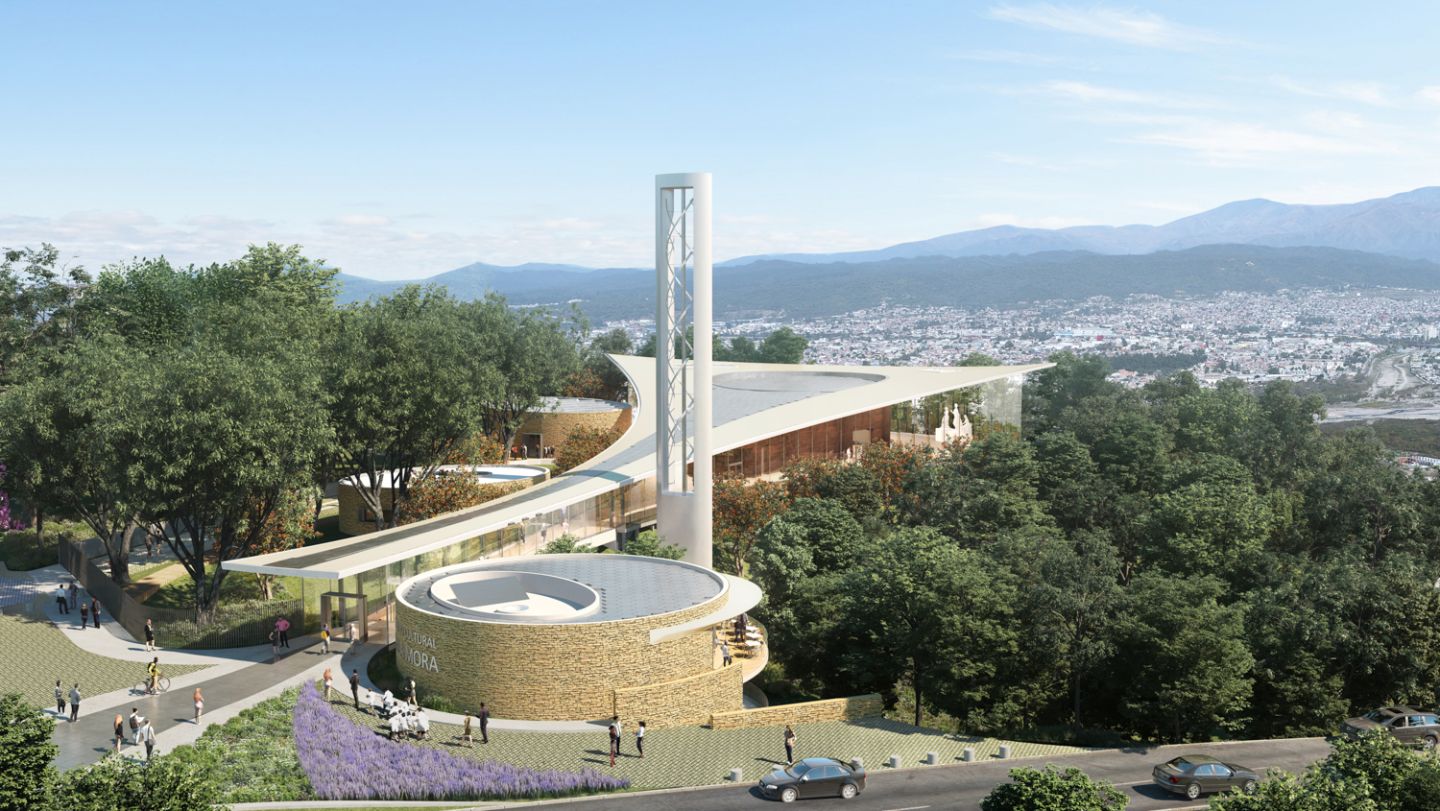
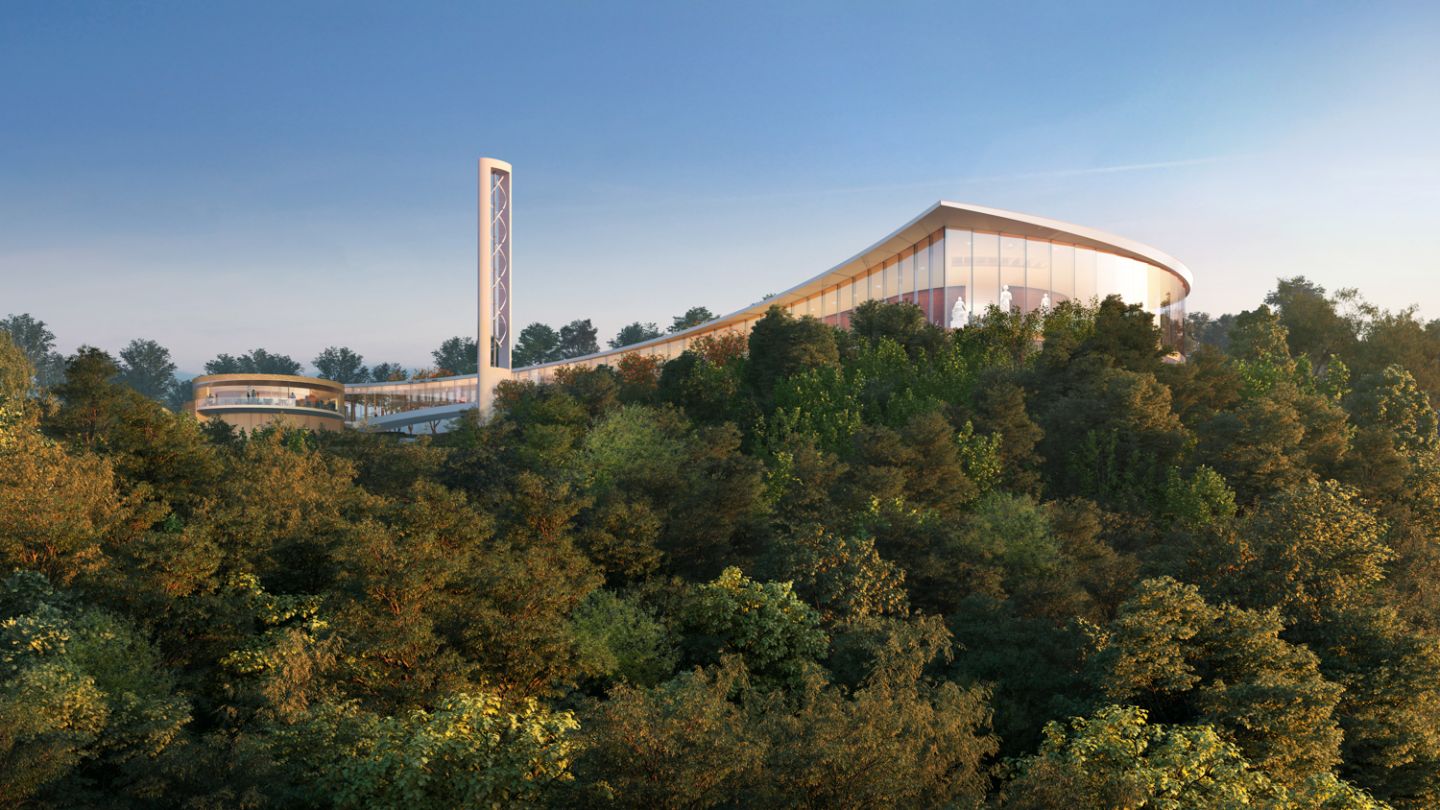
The Lola Mora Cultural Center has opened in San Salvador de Jujuy, Argentina, bringing six sculptures by the pioneering Argentine artist into a purpose-built home designed by César Pelli and Pelli Clarke & Partners. Inaugurated on 2 July 2026, the publicly commissioned complex occupies elevated ground within the Yungas forest, overlooking the city and the mountains beyond. The provincial government presents it as a new cultural and educational venue as well as a destination for visitors to northwestern Argentina.
Its opening also carries unusual architectural weight. Pelli, who was born in nearby Tucumán and died in 2019, developed the project late in his career. Some reports have called it his final building, but the available evidence supports a more careful description: it was among his last designs. The Government of Jujuy says the commission emerged from a meeting with Pelli and that construction began in 2022, while Infobae describes it as his last project. Neither account conclusively establishes that no later Pelli design will be completed.
A museum shaped by a sculptor’s tool
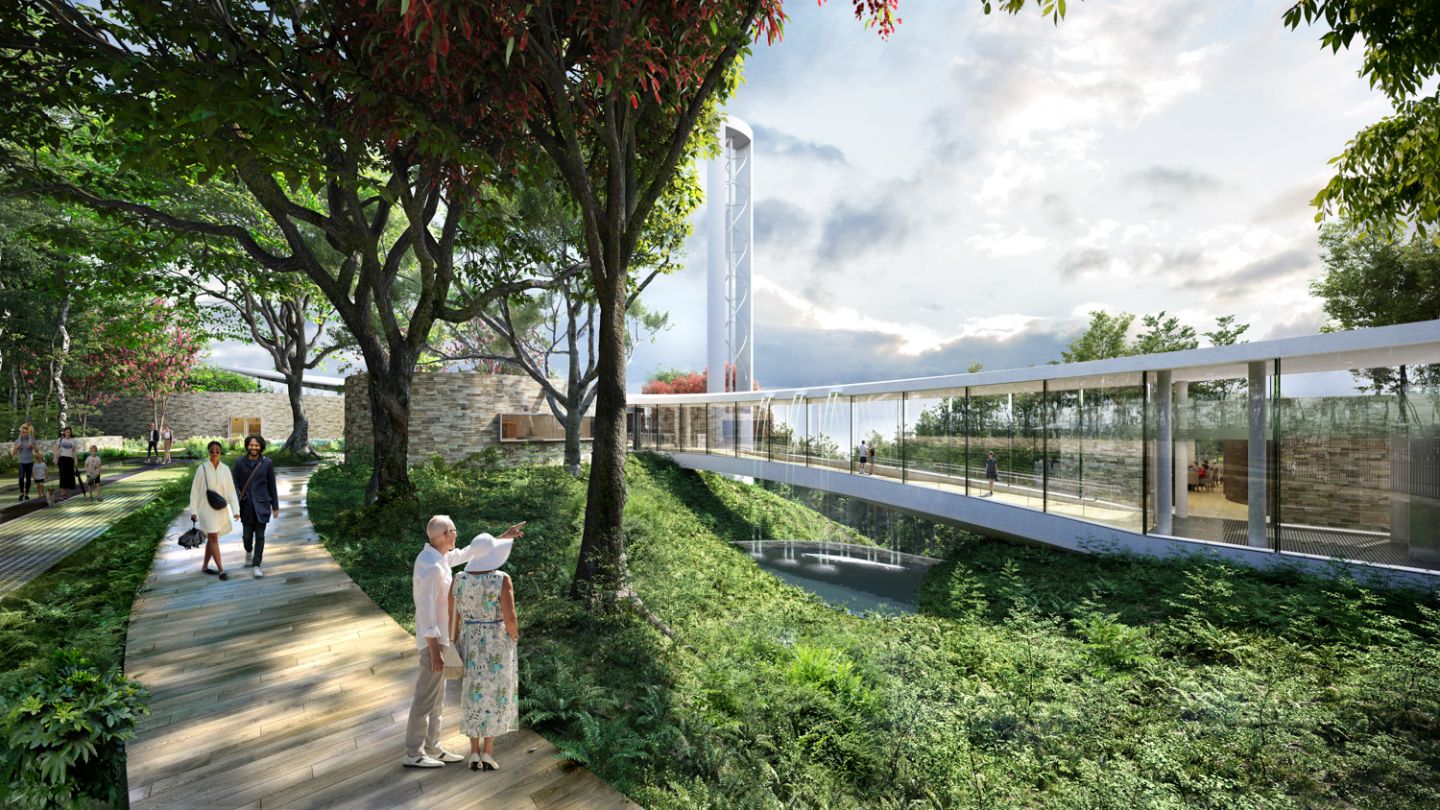
The building’s organizing image is the chisel. A narrow, bridge-like approach forms the implied handle before the plan expands into the principal lobby and exhibition areas. This is not simply a graphic metaphor applied to a roof plan. The transition from compression to release controls how visitors encounter both the collection and the site: the entrance concentrates movement, then the glazed gallery opens laterally toward sculpture, forest and distant topography.
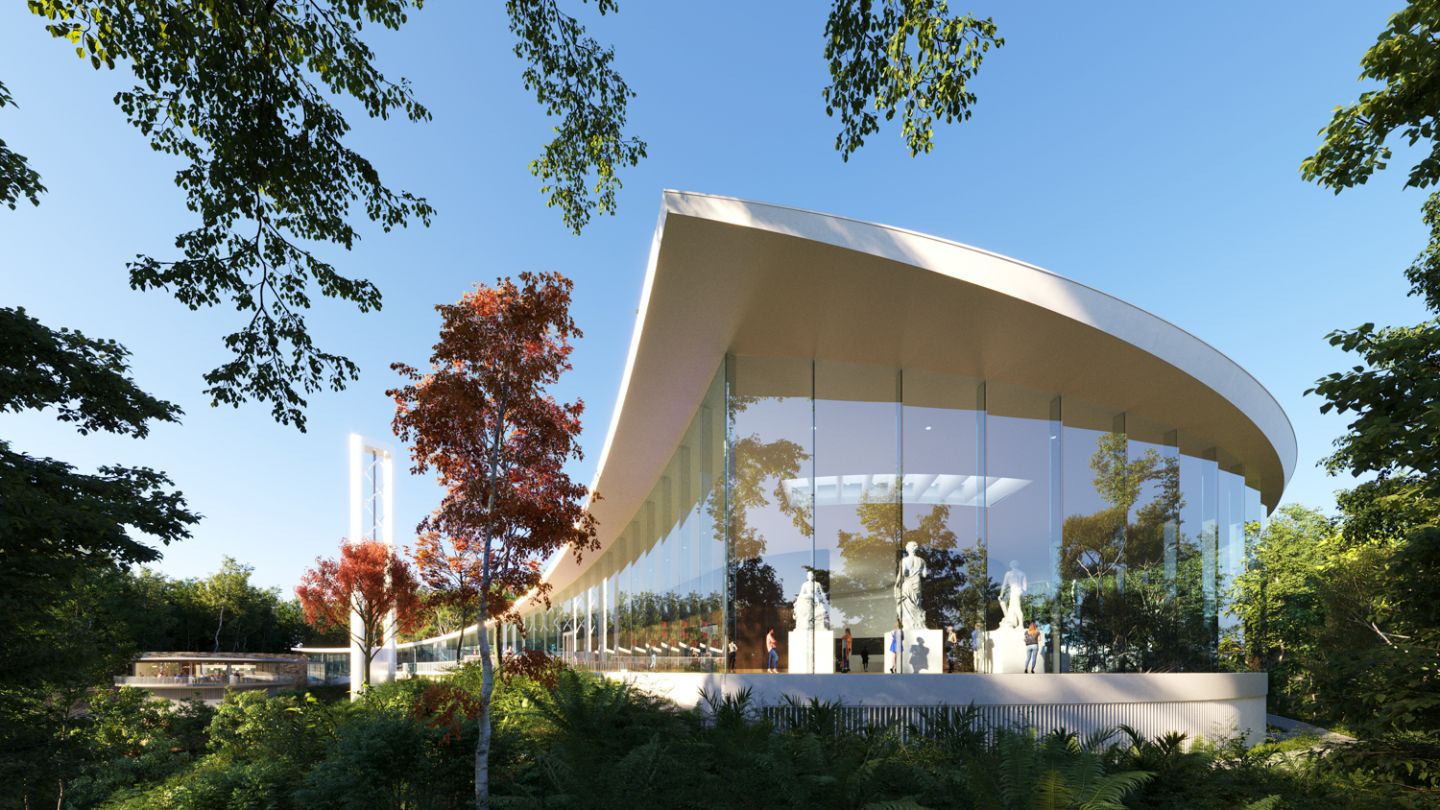
According to Pelli Clarke & Partners, the 3,000-square-metre center includes an interpretation area, library, restaurant, shop and atelier alongside its permanent and temporary exhibition spaces. A cantilevered roof enables broad, column-free interiors, while a convex glass façade and carefully placed skylights bring daylight around the sculptures. The aim is less a sealed white-box museum than a room whose visual boundaries extend into the vegetation.
That openness gives the architecture a curatorial role. Mora’s works can be seen across changing distances and against different backgrounds rather than approached from a single prescribed front. Glass establishes connections between the pale sculptural figures and the dense greens outside, while the roof supplies a strong horizontal datum above them. The building becomes a viewing apparatus: enclosure, frame and overlook at once.
Giving Lola Mora’s work a permanent setting
Born in 1866, Dolores “Lola” Mora established a career in monumental sculpture at a time when the field offered women little institutional access. She trained in Argentina and Italy and became known for public commissions, most famously the Fountain of the Nereids in Buenos Aires. Her work repeatedly encountered moral criticism and political resistance, making the preservation of her legacy inseparable from the history of who was permitted to shape civic space.
The Jujuy center houses six restored works: five allegorical sculptures representing Progress, Liberty, Justice, Peace and Labor, together with a paired-lion composition. As Infobae reports, the pieces were originally associated with Argentina’s National Congress before ultimately becoming part of Jujuy’s provincial heritage. Their relocation from a government building into a dedicated cultural institution changes the terms of access. Objects once embedded in official architecture can now be examined as artworks with complicated civic biographies.
The commission also joins two figures from Argentina’s north across different periods and disciplines. Mora was born near the boundary of Tucumán and Salta; Pelli came from Tucumán before developing an international practice in the United States. In Jujuy, that connection avoids becoming a purely biographical gesture because the project is grounded in local terrain, public stewardship and a collection already belonging to the province.
Environmental systems become architecture
The most conspicuous technical element is a slender tower carrying wind turbines, positioned as a vertical counterpoint to the low, spreading museum. Photovoltaic panels and solar collectors provide additional on-site generation. The architects describe the center as a net-zero-energy design capable of producing 120 percent of its operational energy demand, with a high-performance envelope and mechanical systems reducing consumption by 23 percent. These remain project-team performance claims rather than independently published post-occupancy results, but they make the environmental strategy unusually legible.
Water management is similarly tied to the hillside. The practice says rainwater is collected for irrigation, while small dams capture runoff and limit erosion. This matters in a forest setting where sustainability cannot be reduced to the visibility of turbines or photovoltaic surfaces. Managing drainage, ground disturbance and the relationship between glazed interiors and solar exposure is fundamental to whether the building can inhabit the landscape responsibly.
The chronology deserves clarity. Pelli Clarke & Partners lists the project as completed in 2023, yet the provincial account records construction continuing toward the official July 2026 inauguration. The discrepancy may reflect design completion, a project milestone or differing definitions of architectural completion, but the published sources do not resolve it. July 2026 is therefore the reliable date for the center’s public opening.
What the project may change
The center proposes that cultural infrastructure outside a national capital can be simultaneously local and internationally ambitious. Its value will not ultimately be measured by silhouette alone. The more consequential questions concern programming, conservation, public access and whether its workshops, library and temporary galleries can sustain activity after the novelty of opening passes.
Architecturally, the project is strongest where its ideas overlap: the bridge is both circulation and ceremony; the glass is both enclosure and landscape frame; the energy tower is both equipment and landmark. Such integration gives the building a visual identity without separating expression from use. It also offers a measured late-career statement from Pelli—less a solitary object imposed on the forest than a sequence of framed relationships among art, terrain, technology and civic memory.
Sources
Pelli Clarke & Partners; Government of Jujuy; Lola Mora Cultural Center; Infobae Cultura.
Gallery


Comments
Post a Comment