Z.AI’s GLM-5.3-Flash Makes Multimodal Intelligence a Cost Question

Z.AI has released GLM-5.3-Flash, a native multimodal model designed to combine frontier-level capability with substantially leaner inference economics.
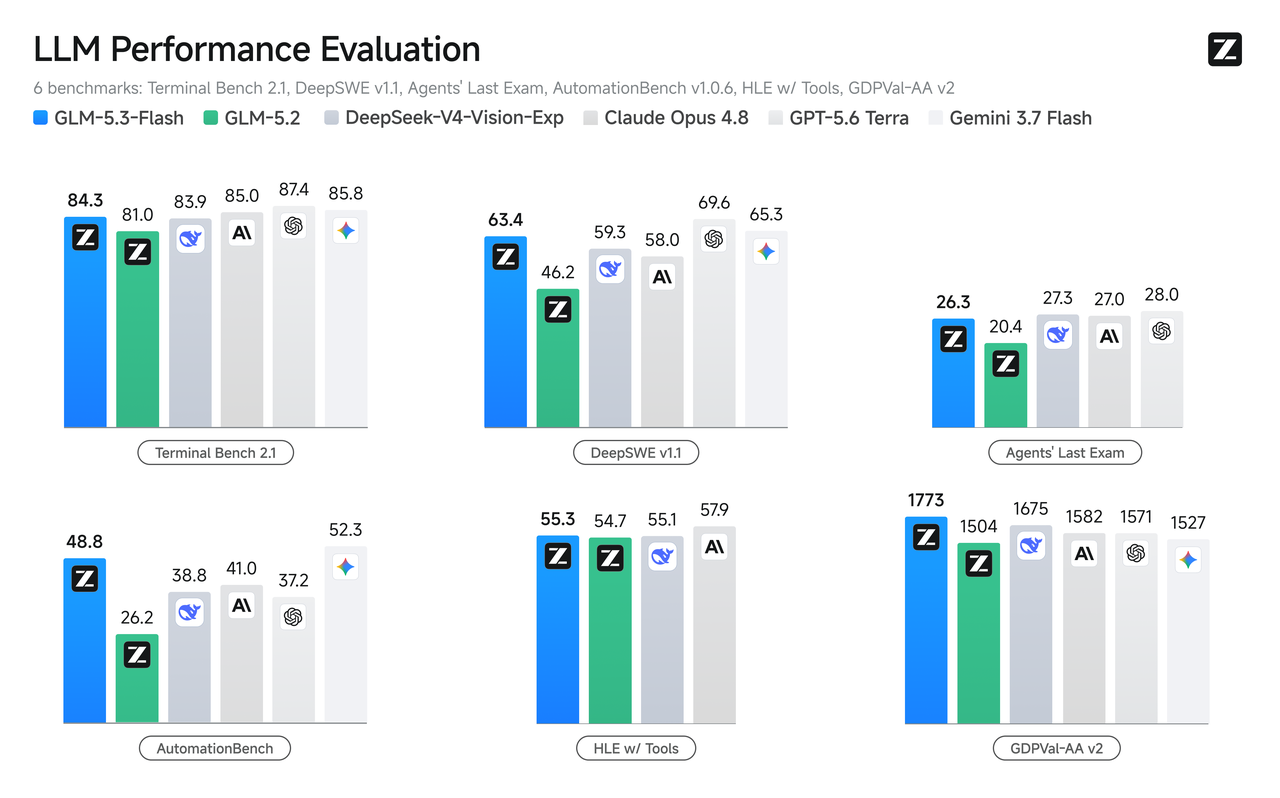
Z.AI has released GLM-5.3-Flash, the first natively multimodal model in its GLM-5 series. Announced on August 26, 2026, the model combines text and visual understanding with an architecture intended to reduce the cost of serving long-context workloads. Z.AI describes it as a 320-billion-parameter system with 18 billion active parameters, and says it outperforms GLM-5.2 across a range of coding, agentic and vision evaluations. The model is available through Z.AI’s services, while its weights have also been published on Hugging Face.
The important news is not simply that another large model has arrived. GLM-5.3-Flash represents a more consequential design direction: multimodal capability is being treated as part of the model’s core operating loop, while efficiency is being engineered into the attention mechanism, deployment stack and hardware relationship. That combination matters because visual reasoning becomes most useful when a model can repeatedly look, act, inspect and revise without making every interaction prohibitively expensive.
A smaller active footprint inside a large model
GLM-5.3-Flash uses a mixture-of-experts-style configuration in which the total model is much larger than the portion activated for any individual token. Its 320B total parameters and 18B active parameters create a distinction between stored capacity and working computation. In principle, that allows the system to retain broad representational depth while limiting the amount of computation required at each step.
Z.AI’s central architectural change is a hybrid of sparse attention and linear attention. Linear attention is used to model local dependencies through a state-based mechanism, while sparse attention retrieves relevant information from the wider context. The company also describes an indexing system, called IndexPool, that compresses indexer key vectors for very long contexts. These choices are aimed at the practical bottlenecks of inference: memory movement, attention computation and the size of the key-value cache.
According to Z.AI’s technical description, the model is designed for contexts reaching up to one million tokens. That figure should be read as a systems target rather than a guarantee that every task will benefit equally from such a window. Still, the direction is clear. Long context is no longer only a question of how much information a model can theoretically accept; it is a question of whether that information can be processed at a viable cost.
Native multimodality changes the workflow
GLM-5.3-Flash’s visual capability is positioned less as an add-on for image questions and more as a feedback mechanism for interactive work. Z.AI highlights frontend development, game development, three-dimensional simulation and computer-use tasks in which the final result is not merely a block of code. It is a rendered interface, a navigable environment or a sequence of actions that must be judged in context.
This distinction is important. Traditional software evaluation can often stop at whether code compiles or whether a test returns the expected value. Visual software introduces another layer of correctness: spacing, hierarchy, affordance, state changes and the experience of moving through an interface. A model that can inspect its own rendered output can participate in a loop closer to human design practice—make a change, observe the result, identify a defect and revise.
Z.AI says it developed data-synthesis pipelines and reinforcement-learning methods around visual coding, including environment feedback and agent-based verification grounded in real user flows. The claim is not that vision automatically produces good design. Rather, visual input gives an agent access to evidence that text-only evaluation cannot capture. That evidence can make its corrections more grounded and its failures easier to diagnose.
The economics are part of the product
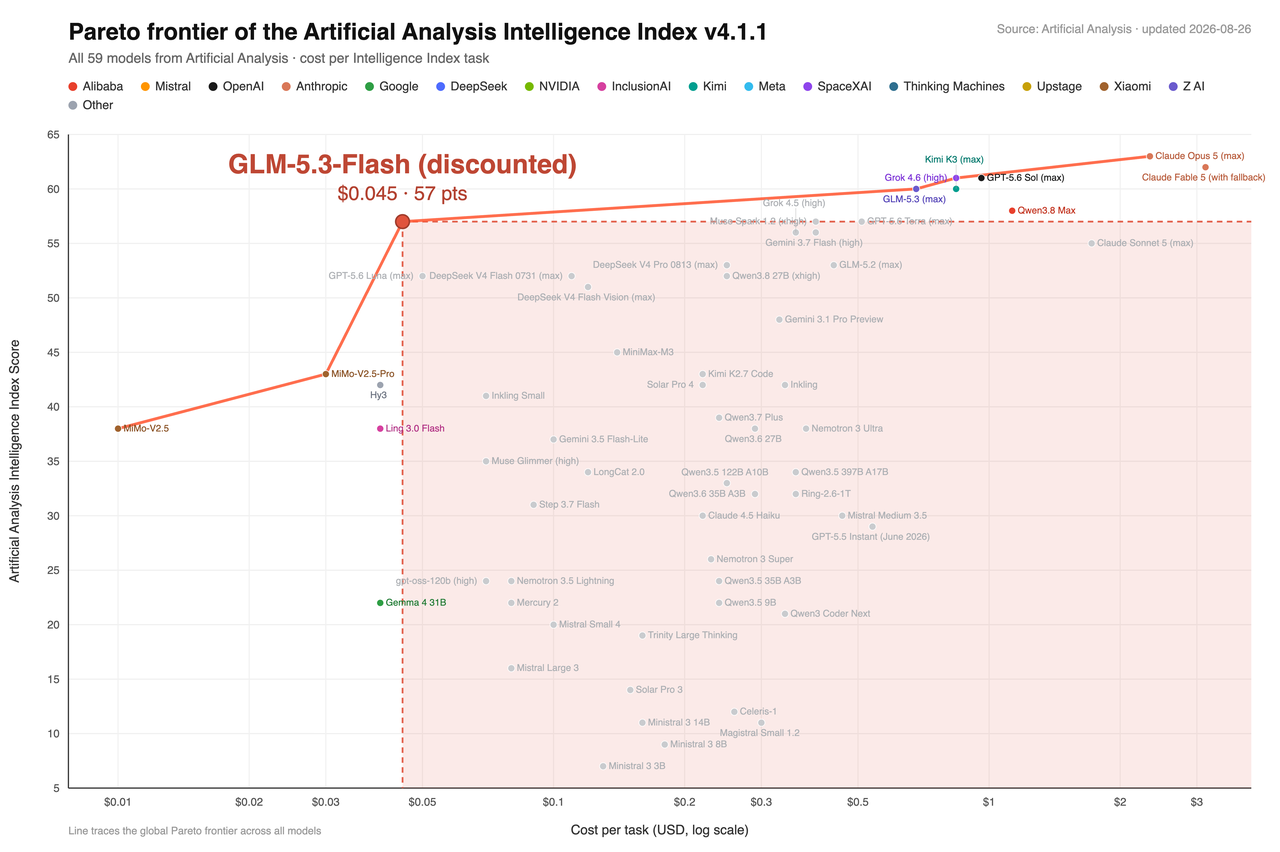
Z.AI presents GLM-5.3-Flash as a cost-efficient alternative to larger frontier systems. Its announcement cites a score of 57 on the Artificial Analysis Intelligence Index at a discounted cost of $0.045 per task, and reports gains over GLM-5.2 on coding and agentic benchmarks. Those figures are vendor-reported and should be interpreted alongside evaluation setup, prompting, model effort and pricing conditions. They are useful indicators, but not a substitute for independent testing across real workloads.
The more durable point is the model’s stated efficiency profile. Z.AI says GLM-5.3-Flash has roughly half the activated parameter count and fewer layers than its GLM-4.5-era comparison point, while reducing attention computation and key-value cache size relative to GLM-5.3. If those reductions translate reliably into production, the model could make multimodal agents practical in settings where repeated visual inspection would otherwise be too costly.
That matters for product teams. A model used once to summarize an image has a very different cost profile from an agent that opens a browser, navigates several screens, reads a chart, edits a page and checks the result again. In the latter case, inference economics shape the possible interaction design. Lower cost does not merely improve margins; it permits more observation, more verification and more iterative behavior.
Open weights, local deployment and hardware independence
GLM-5.3-Flash is released with an MIT license on its Hugging Face model repository. The model card lists support for deployment frameworks including SGLang, vLLM, TokenSpeed and KTransformers, giving developers several paths toward local or private infrastructure. The model’s scale means that “open” does not make deployment lightweight, but it does widen the space for experimentation, optimization and regional hosting.
Z.AI also says it served the model on a large cluster of Chinese AI accelerators, using a dedicated inference engine and techniques including quantization, tensor parallelism and disaggregated encoding, prefill and decoding. This is significant because model efficiency is partly architectural and partly infrastructural. A design that performs well only on one dominant accelerator ecosystem has a narrower practical reach. Hardware-aware serving can turn an abstract efficiency claim into a measurable operating advantage.
What GLM-5.3-Flash signals
GLM-5.3-Flash arrives at a moment when the most interesting competition in AI is shifting from raw scale toward usable intelligence per unit of compute. Native multimodality, long-context efficiency and open deployment are converging around a common ambition: agents that can work inside the visual and structured environments where people actually spend time.
The model should not be understood as proof that benchmark scores have settled the frontier. Independent reporting from IT Home confirms the launch and its native multimodal positioning, but broader assessment will depend on hands-on deployments and third-party evaluations. The immediate significance is architectural. Z.AI is treating perception, reasoning, action and cost as one design problem. For multimodal systems, that may be the more important frontier.
Sources
Z.AI announcement; Z.AI developer documentation; Hugging Face model card; IT Home report.
Gallery


Comments
Post a Comment