Janet Echelman’s Aerial Sculpture Reframes Frankfurt’s Konstablerwache
A Sky Full of Hope uses a responsive net, changing light and the activity below to turn a hard-edged transit square into a civic room.

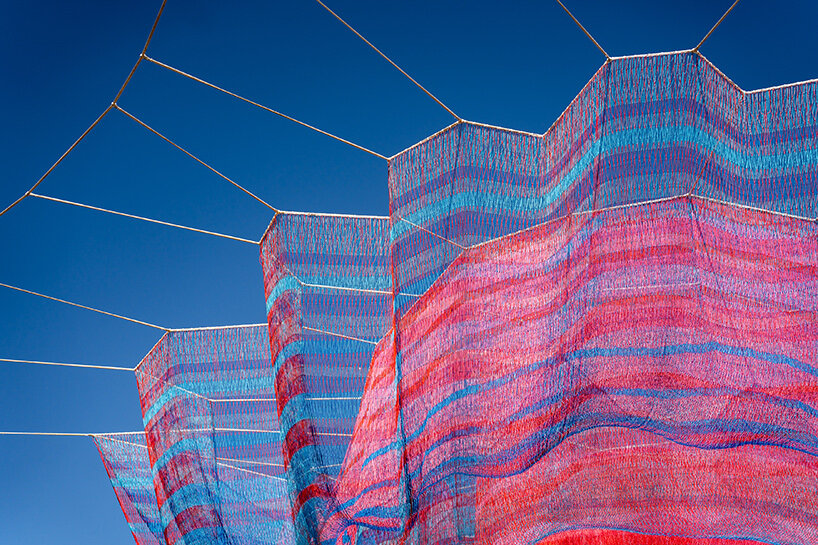
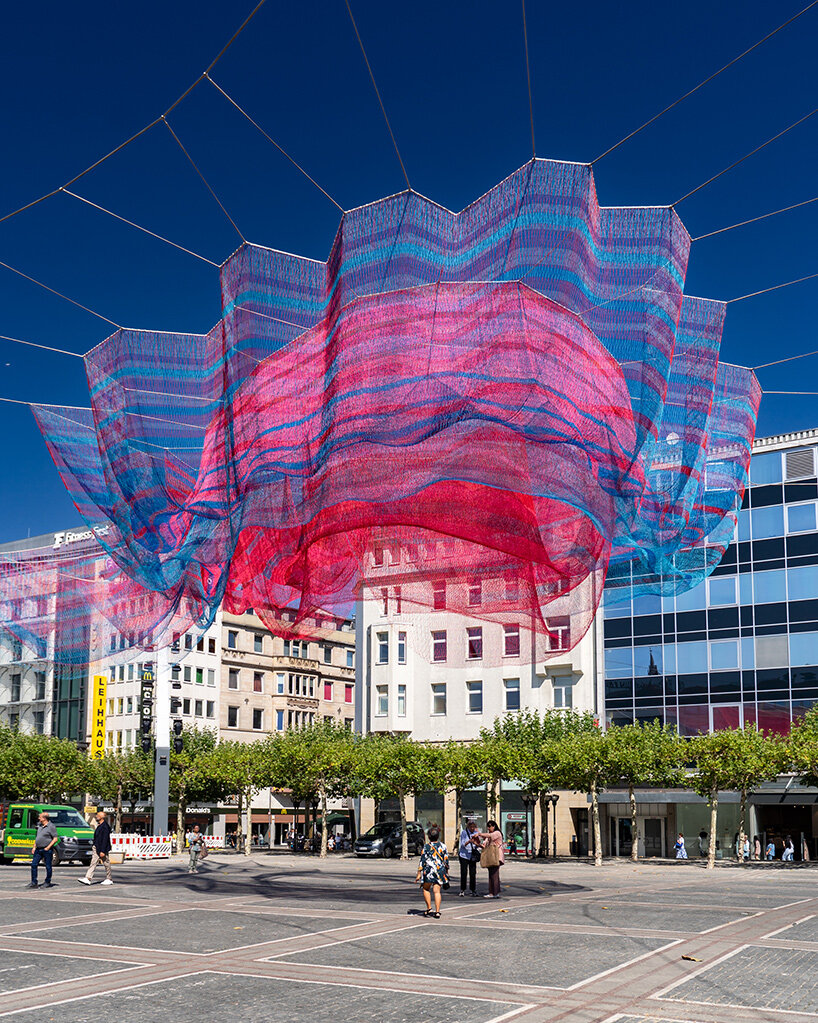
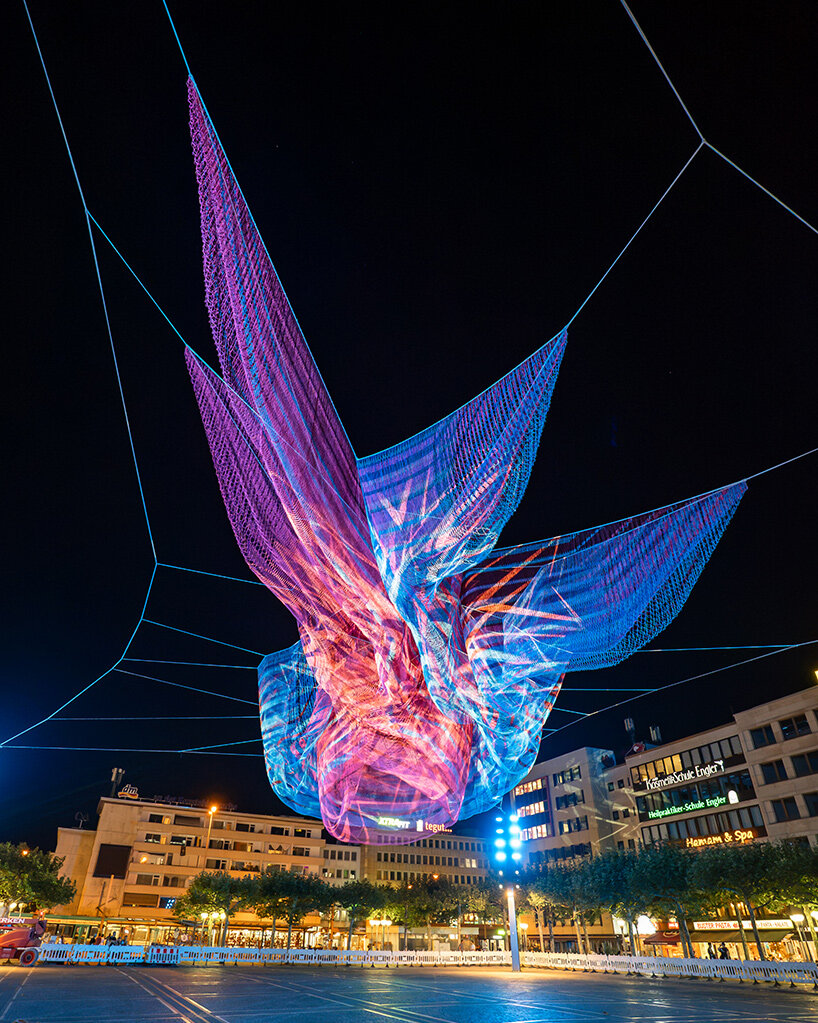
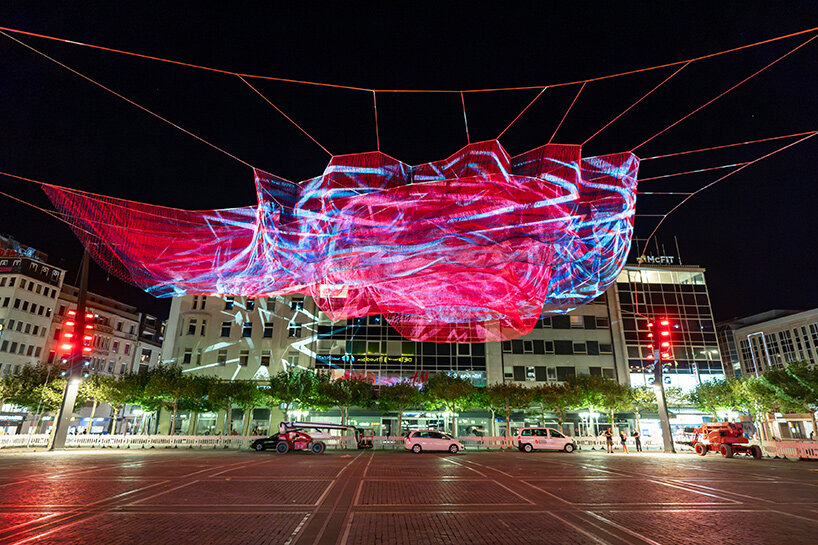
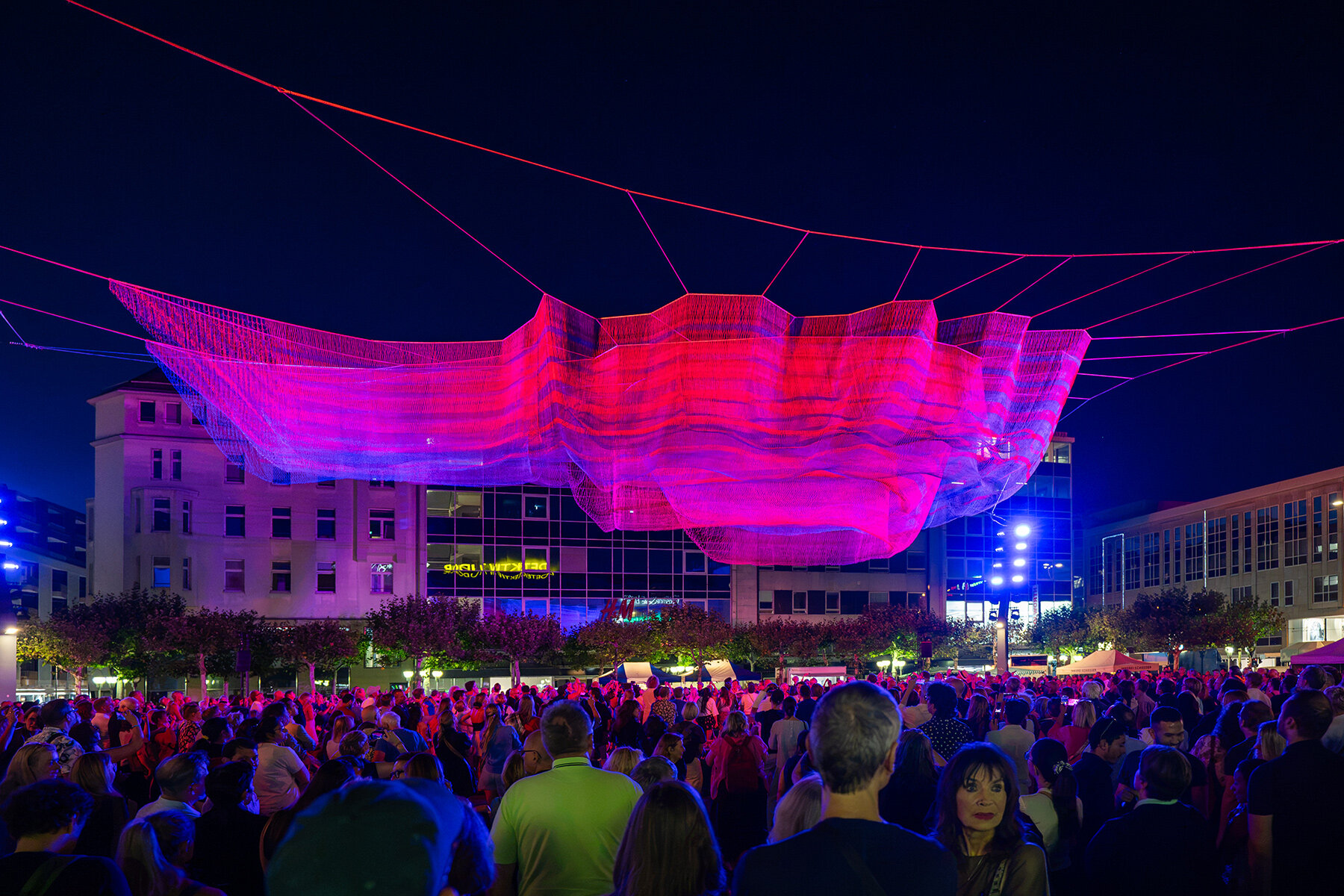
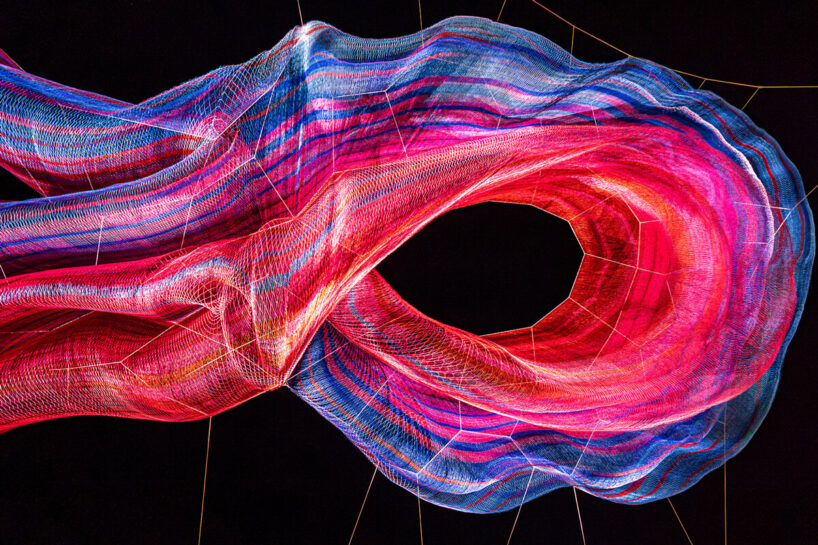
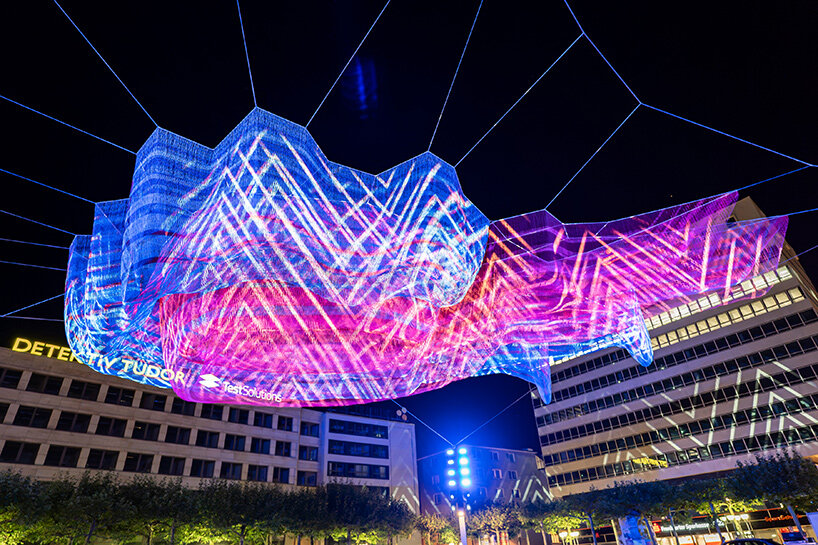
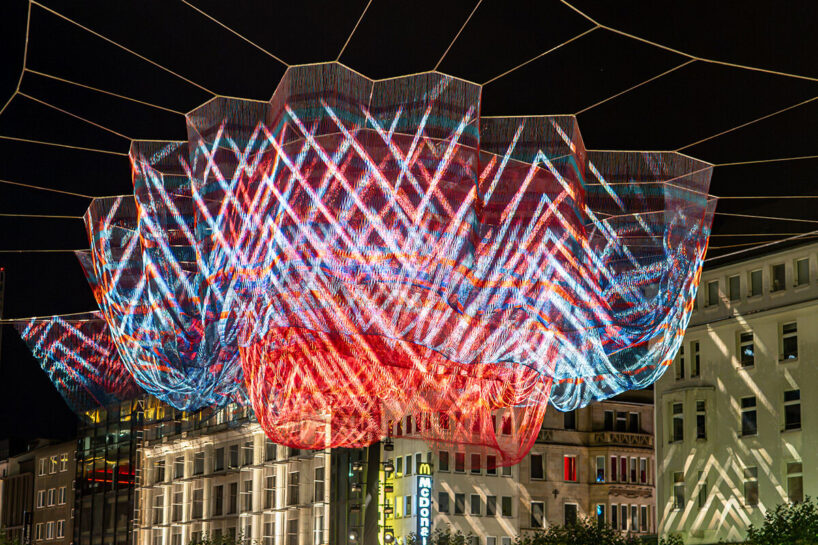
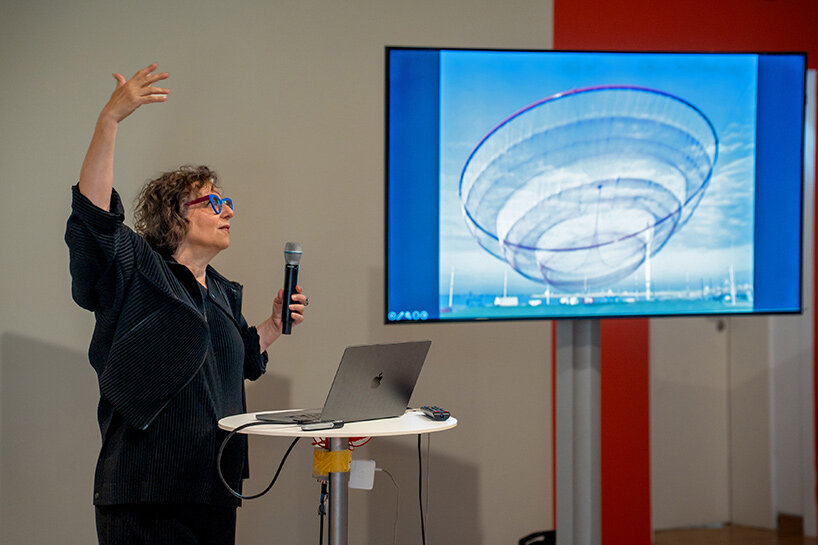
Janet Echelman’s monumental net sculpture A Sky Full of Hope – Earthtime 1.78 Frankfurt now spans Konstablerwache, one of central Frankfurt’s busiest and most contested public spaces. Created for World Design Capital Frankfurt RheinMain 2026, the aerial work replaces the square’s previously unbroken overhead void with a suspended field of coloured fibres. Wind, weather and daylight continually adjust its outline, while illumination gives it a second, more saturated identity after dark.
The installation was commissioned by Frankfurt’s Department of Culture and Science and designed specifically for this location. The official World Design Capital programme describes it as a new atmospheric and social landmark: a “living sculpture” whose experience evolves through light, movement and the ways people occupy the square. Its ceremonial illumination was scheduled for 11 August, followed by a public light-and-sound presentation. The programme now lists that opening among its past events, although no separate post-opening report was available in the evidence reviewed.
A soft structure over a hard square
Konstablerwache is not an ornamental setting. It is an intensely used transport interchange, meeting point and market site, defined by broad paved surfaces and the practical pressures of circulation. The official project description calls it a place of transit, encounter and friction. Echelman’s intervention does not conceal those conditions. Instead, it introduces a new spatial layer above them.
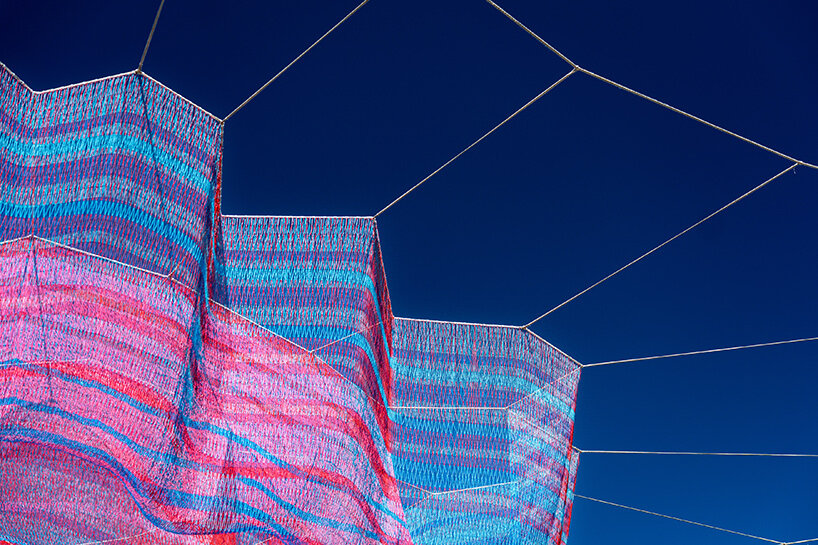
Four steel pylons support the suspended net, with the installation reaching up to 17.25 metres in height. Construction required the temporary relocation of the twice-weekly producers’ market while foundations and supports were installed, according to the City of Frankfurt’s construction notice. The market was expected to return beneath the sculpture once the principal overhead work was complete. That sequence is significant: the artwork was conceived around an existing civic routine, not for an emptied or culturally neutral plaza.
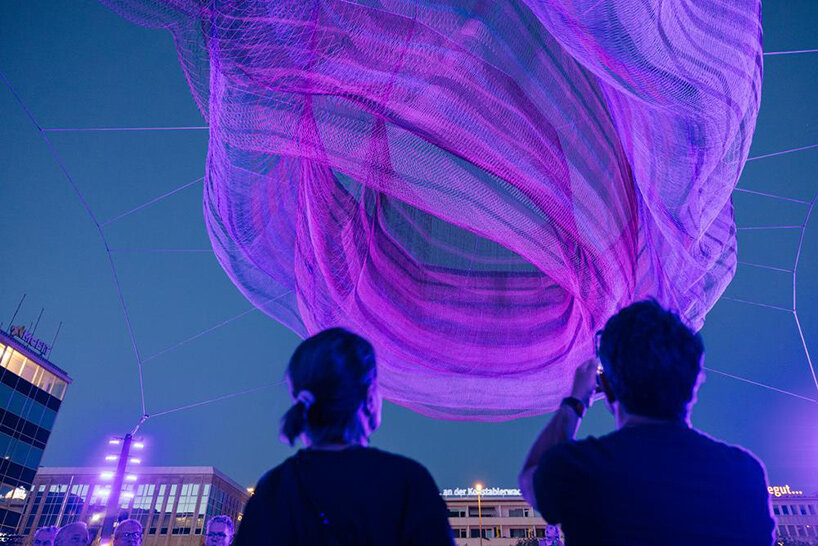
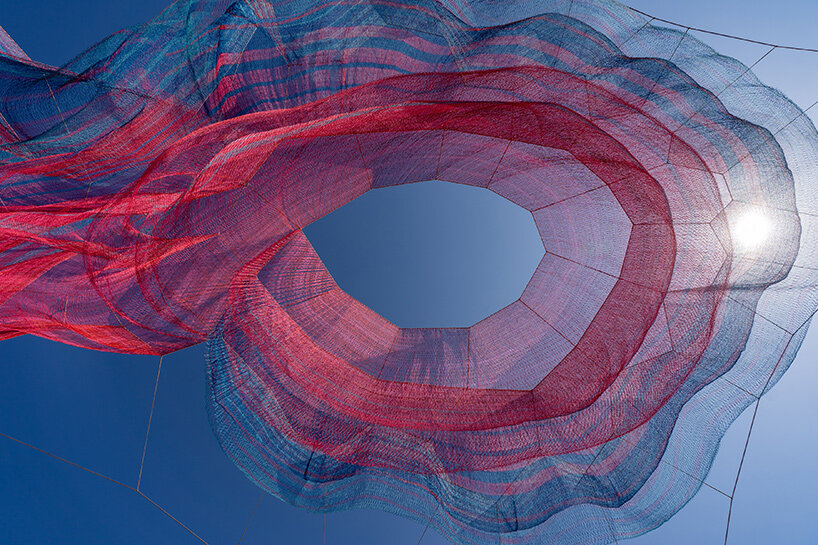
The resulting form is substantial without reading as solid. Its woven volume gathers and releases the sky, sometimes appearing taut and architectural, sometimes loose and cloudlike. Movement comes from environmental forces rather than motors or a fixed animation cycle. The German Design Council notes that Echelman’s aerial sculptures continually change in response to wind, light and surrounding architecture. In Frankfurt, that responsiveness makes the square’s atmosphere unusually legible: a breeze becomes deformation, fading daylight becomes a shift in colour and depth.
Colour as civic language
The title’s number refers to Frankfurt’s residents originating from 178 nations, a demographic fact used as the conceptual starting point for the commission. The project frames the net as an image of interdependence: individual strands gain stability through connection. A site-specific palette balances warm and cool tones, intended to evoke cultural plurality alongside the relationship between human systems and the natural world.
This symbolism is direct, perhaps deliberately so. Public art in a major interchange cannot assume prolonged attention or specialist knowledge. The net communicates first through scale, chromatic contrast and movement; its themes can be encountered later. That order gives the work visual generosity. A commuter can register a changing ceiling, a market visitor can experience a newly defined room, and someone who chooses to stop can follow the work’s ecological and social propositions.
It is important, however, to distinguish between environmental responsiveness and physical participation. Visitors do not appear to manipulate the suspended fabric directly. Public use changes the social composition and perception of the space beneath it, while wind and weather reshape the net itself. The interaction is therefore relational rather than hands-on: artwork, atmosphere, architecture and crowd remain separate agents whose effects overlap.
Designing attention rather than an object
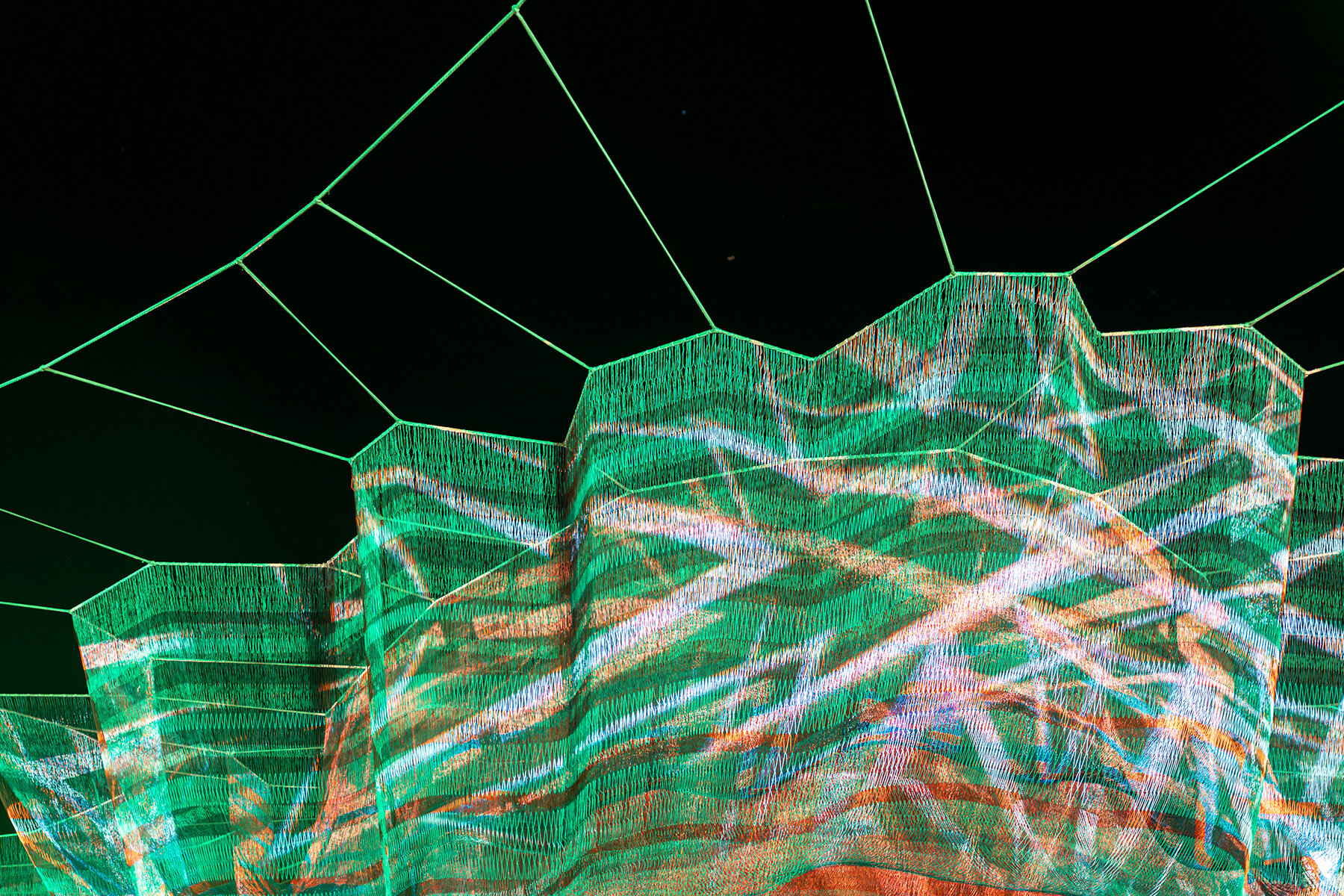
Echelman’s project belongs to a wider practice that combines traditional net-making principles with computational modelling and engineering associated with large tensile structures. Frankfurt’s official account describes her process as joining knotting techniques with 3D software and aerospace technology. This hybrid method allows a visually delicate form to operate at an urban scale, where wind loads, anchoring and long-term exposure are fundamental design conditions rather than secondary technical matters.
The engineering is present but visually recessed. What people encounter is not an explanation of forces but their visible consequence. That makes the sculpture a useful example of design as choreography: its primary material is not simply fibre, steel or coloured light, but changing attention. It asks people moving horizontally across the square to look upward, slow down and notice conditions that are ordinarily treated as background.
Night lighting extends that strategy. During the planned opening presentation, ground-based illumination, dynamic light sequences and spatial sound were intended to make the net appear to awaken and breathe. Beyond the launch spectacle, illumination gives the suspended structure civic visibility during the hours when a transport square can otherwise feel most severe. The risk with such treatments is that public space becomes a branded image or event backdrop. The more consequential test will be whether the work supports ordinary occupation after the inaugural programme has passed.
A three-year urban experiment
The city expects the installation to remain at Konstablerwache for three years, provisionally until summer 2029. That duration places it between an event installation and permanent public art. It is long enough for novelty to fade, seasonal weather to reveal different behaviours and local routines to form around the altered space. It also allows the city to observe whether an atmospheric intervention can meaningfully change how a difficult square is perceived and used.
Frankfurt has presented the commission as part of a broader transformation of the city centre. Such ambitions deserve measured scrutiny: a suspended artwork cannot resolve the economic, social or infrastructural pressures concentrated in a major interchange. It can, however, demonstrate that urban improvement is not limited to replacing paving, adding retail or controlling circulation. Sensory character, shared attention and an invitation to linger are also design infrastructure.
A Sky Full of Hope is most persuasive when understood in those terms. It does not complete Konstablerwache or offer a simple emblem of harmony. It establishes a changing canopy over a place already full of differences, schedules and competing needs. Its design significance lies in making those conditions feel connected without making them uniform—and in giving an uncompromising square a new, responsive horizon.
Sources
World Design Capital Frankfurt RheinMain 2026; City of Frankfurt; German Design Council; Kunst im öffentlichen Raum Frankfurt; Designboom.
Gallery



Comments
Post a Comment